
GET STARTED TODAY
Why wait another day?
Discover how we help children develop skills and attributes that are important for future happiness and success.
Come visit us and learn more.
Book A Tour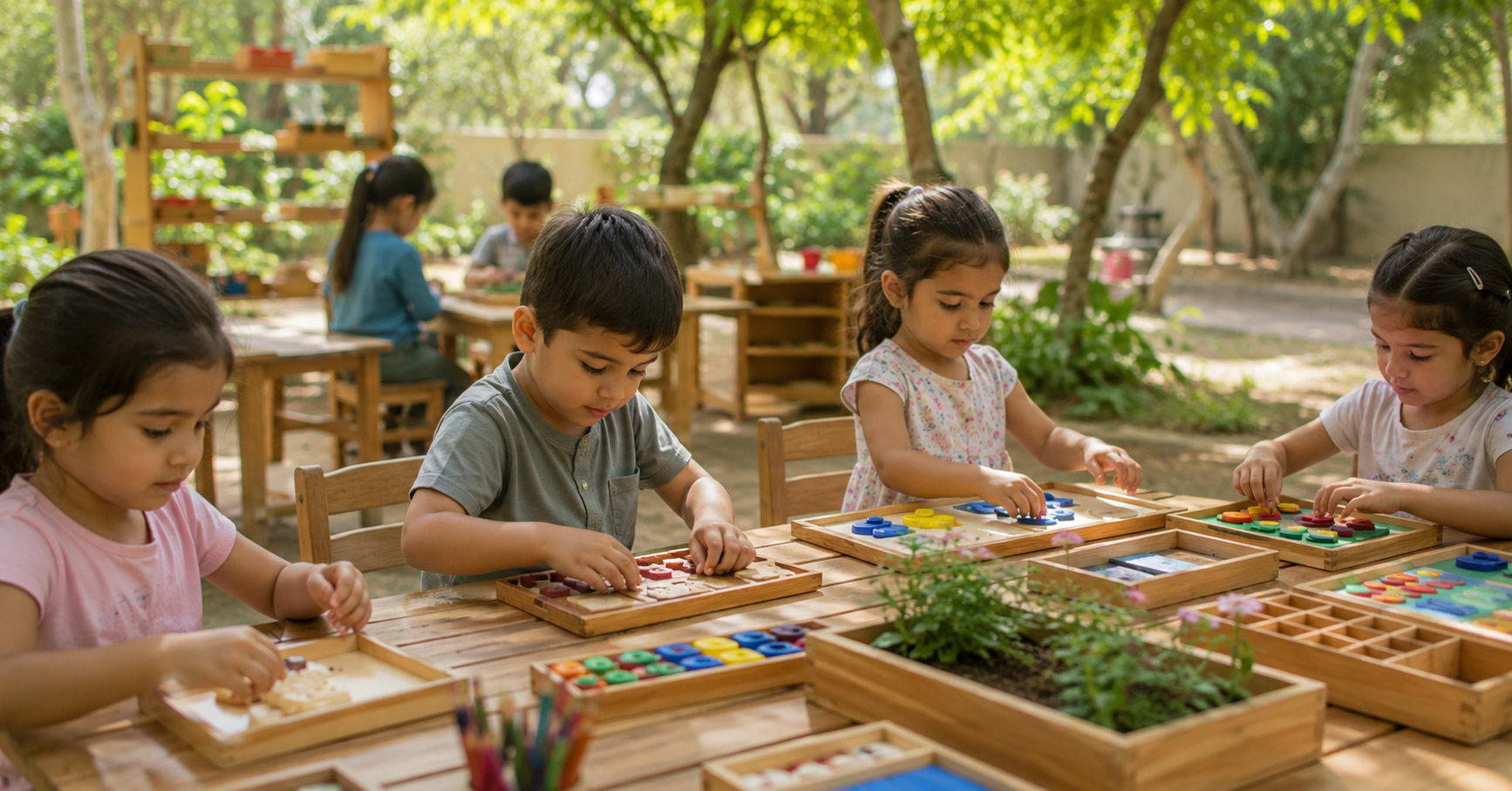
Summer camp should make you feel as fresh as a daisy. It should not be like an additional few months of school. Parents sometimes have concerns about “The Summer Slide. We are worried our children will lose the skills they have gained in reading and math during the long break. A Montessori Summer camp has a solution to that. Say goodbye to the rigid time and compulsory crafts. Instead, it provides freedom, responsibility and hands-on discovery.
When children step into a Montessori camp, their attitude changes. They stop asking adults to entertain them. They find themselves in a natural environment that encourages exploration. This simple shift turns everyday playtime into deep, natural learning.
Here are the real activities that make summer both highly educational and incredibly fun.
In a standard classroom, young children practice fine motor skills by pouring beans or buckling a cloth frame. In the summer, these lessons move outside into the wild. The tasks become completely real.
Campers don’t use plastic toy kitchens but rather child-safe knives. They work in real gardens. They play in the dirt; they plant seeds and water the crops. This teaches biology and nutrition much better than a textbook.
We have all seen traditional camp crafts. Thirty children follow the exact same steps. They all take home thirty identical paper plate frogs. The Montessori approach completely rejects this style. It values the creative process much more than the final product.
Instead of templates, kids get raw materials. They use clay, watercolors, charcoal, and items from their nature hikes. They make beautiful artwork from twigs, pressed flowers and smooth stones!
If you back away and allow children to have quality materials and no hard rules, they really pay attention. Their art is a way to tell a story of how they see the world.
Science should not feel like memorizing facts for a test. Summer provides the best laboratory right outside the back door. Children can study earth science, biology, and zoology through direct experience.
Each camper has a magnifying glass and a basic field guide. They trace animal tracks, learn about bug homes, and weigh and classify rocks by color. They run simple experiments. They test which natural objects sink or float in a nearby creek. They observe how various soil forms absorb water when it rains heavily.
A muddy puddle can teach quite a lot to a little boy or girl about gravity and fluid dynamics. Their brains are actively sorting out how the physical universe works.
Maria Montessori loved teaching children about “Cosmic Education.” This is the idea that everything in our world connects together. Summer is the perfect time to explore this big concept through active games.
Campers learn to read trail maps and use physical compasses. They even draw layouts of their own camp boundaries. This builds excellent spatial reasoning. Many programs host cultural weeks. They explore a specific continent through its traditional music, food, and oral storytelling.
Kids also track the sun’s movement using a homemade sundial. This connects the concept of time to the physical rotation of our planet.
Conventional camp activities are full of aggressive sports. Despite the benefits of sports, they can cause stress for children who are not born athletes. Montessori movement activities focus on cooperation and personal limits.
Children design their own physical challenges. They put up obstacle courses using logs, old tires and balance beams. They enjoy games involving teamwork, such as giant scavenger hunts.
When adults stop micro-managing, it is amazing how fast children learn about physical risks. They find out just how high they can go safely. They master balance and make their own decisions.
To stop the summer learning slide, reading and writing are woven directly into the daily camp routine. There are no boring worksheets here.
Older kids carry field journals. They sketch their daily plant discoveries and write down observations about the weather. Reading corners are established with blankets and hammocks under trees in the shade. They fill these spaces with books about animals and outer space. This naturally expands their vocabulary and builds confidence.
Search for a summer program that sees your child as an able explorer. A good camp offers long blocks of uninterrupted playtime and uses natural materials. By enrolling your child in a registered Montessori school summer camp, you know that they will be part of what is truly present in this child-led approach. Parents who live near Princeton should consider enrolling their child in a summer camp for a wonderfully prepared, stimulating summer experience.
A really wonderful Montessori Summer Camp is measured by freedom, sensory learning and outdoor adventure in perfect balance. These courses involve real-life skills, open creativity, and cooperative play. They prove that summer vacation can be deeply educational without losing a single ounce of fun.
The majority of camps include children as young as toddlers through young teens. They bring together all the different age groups, so older children are able to assist the younger children.
The fun shifts into cool indoor classrooms. Instructors use that time for indoor science experiments, baking, art projects, and reading until the weather gets better.
Yes, these camps welcome all children. The independent, friendly setup makes it very easy for new students to fit in and adapt within the first few days.
Discover how we help children develop skills and attributes that are important for future happiness and success.
Come visit us and learn more.
Book A TourVisit the school | Meet the team | Let us get to know you and your child
Partner with educators | Be involved | See your child grow
Skills for today and tomorrow | Happiness and success for life