
GET STARTED TODAY
Why wait another day?
Discover how we help children develop skills and attributes that are important for future happiness and success.
Come visit us and learn more.
Book A Tour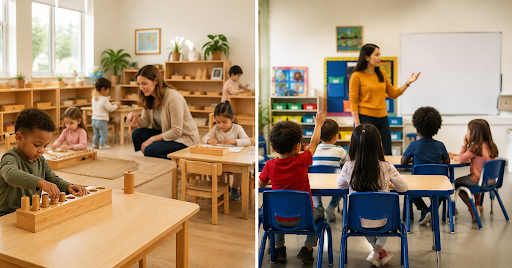
Montessori vs traditional preschool comes down to one simple difference. Montessori programs generally give children more choice within a carefully prepared environment, while traditional preschools tend to use more teacher-led activities and a shared daily schedule. Neither one is better in general.
We have run a Montessori classroom for over 25 years. In that time, we have learned something simple but true. The same activity can calm one child. It can completely lose another. That is why this decision needs more than a quick label.
Walk into a Montessori classroom. It won’t look like a typical preschool. You won’t see rows of desks facing a teacher. Instead, you’ll see low shelves. They’re stocked with hands-on materials. Children work alone or in small groups. The teacher moves quietly between them. She guides. She doesn’t instruct.
Children choose their own “work” from what’s available. It might be pouring exercises. It might be number rods or puzzle maps. They can spend twenty minutes on one activity. Or they can move through several. You’ll also see mixed-age classrooms often. A four-year-old might sit next to a six-year-old. Both learn something from that.
This isn’t chaos, even though it looks relaxed. The materials are carefully designed, and teachers watch closely. They know when a child is ready for something new. The goal is simple: build independence. Children learn to make their own decisions.
Traditional preschools feel more familiar to most parents. The day is broken into blocks. There’s circle time, art, snack, outdoor play, and story time. The teacher leads each activity. Most kids do the same thing at the same time.
This structure has real value. It teaches kids to follow directions. It teaches them to work within a schedule and function as part of a group. These are skills your child will need in kindergarten. Traditional preschools also include more group games. Some children do better with this than with self-directed work. We’ve noticed that anxious kids often relax once they know what’s coming next. A clear schedule can feel comforting to them.
The curriculum is usually set by the school. Sometimes it follows state early learning standards. So there’s less flexibility day to day. But there’s also less guesswork about what your child will learn each week.
Let’s break down where the two styles really differ. In Montessori, your child sets the pace. In traditional preschool, the whole class moves together. Montessori rooms use open shelves. Kids can reach materials on their own. Traditional rooms are usually built around teacher-led stations. In Montessori, the teacher mostly watches and guides. In traditional preschool, the teacher directs and instructs. Montessori often mixes ages within a three-year range. Traditional preschools usually group kids by a single age.
Even the way progress gets tracked is different. Montessori teachers watch your child’s actual work and choices. Traditional preschools often use checklists or report cards. None of this makes one approach better than the other. They just ask different things from your child. In our experience, your child will usually show you pretty quickly which one feels right for them.
This is the question that really matters. Think about your child for a moment. Are they naturally curious? Do they like to work alone? Do they get bored with repetition? If yes, Montessori might be a great fit. The freedom to explore keeps kids like this engaged. They build real confidence by mastering things their own way. We’ve watched quiet, thoughtful kids truly open up in this setting. Once they realize no one will rush them, something shifts.
Now think about a different kind of child. Do they thrive on routine? Do they enjoy group activities? Do they look to a teacher for a clear direction? If so, traditional preschool may suit them better. A steady schedule and constant peer interaction can feel comforting, not limiting.
Parents ask us this all the time. Here’s the honest answer: it depends on the child, not the model. Long-term studies have followed Montessori students into elementary school. Many show strong results in reading, math, and social problem-solving. Traditional preschool graduates do well too. They often adjust smoothly to a structured classroom, since that’s close to what kindergarten looks like.
What matters more than the model is the teacher. It’s the consistency of the environment. It’s how engaged your child is day to day. A well-run program of either type will prepare your child well, as long as the teachers are attentive and trained. We’ve watched graduates from both styles start kindergarten with confidence. What set them apart wasn’t the school model. It was how much independence they’d practiced, both at school and at home.
Don’t decide based on a website alone. Book a tour and watch a class in session if you can. Ask yourself a few simple questions while you’re there. Are the kids actually engaged, or just quiet? Does the teacher know each child by name? Does the classroom feel calm, or does it feel rushed? Ask the staff how they handle a child who’s struggling, whether it’s with an activity or a friend. That one answer will tell you more than any brochure.
We’re New Horizons Montessori, and we’ve been teaching the Montessori method since 1998. That’s over 25 years of hands-on experience with exactly the kind of questions you’re asking right now. Our programs run from Pre-Primary through full-day Kindergarten. Our teachers are trained in authentic Montessori practice. Our classrooms are built around the same child-led approach we’ve described in this article. If you want to see it for yourself, we’d love to have you book a tour and meet our children and teachers in person.
There’s no single right answer to Montessori vs traditional preschool. Montessori works well if your child thrives with independence and hands-on exploration. Traditional preschool suits kids who do best with routine and group-paced learning. The best way to decide is to watch your child. Visit a few classrooms in person. Choose the place where they seem most like themselves: curious, comfortable, and ready to learn.
Discover how we help children develop skills and attributes that are important for future happiness and success.
Come visit us and learn more.
Book A TourVisit the school | Meet the team | Let us get to know you and your child
Partner with educators | Be involved | See your child grow
Skills for today and tomorrow | Happiness and success for life