
GET STARTED TODAY
Why wait another day?
Discover how we help children develop skills and attributes that are important for future happiness and success.
Come visit us and learn more.
Book A Tour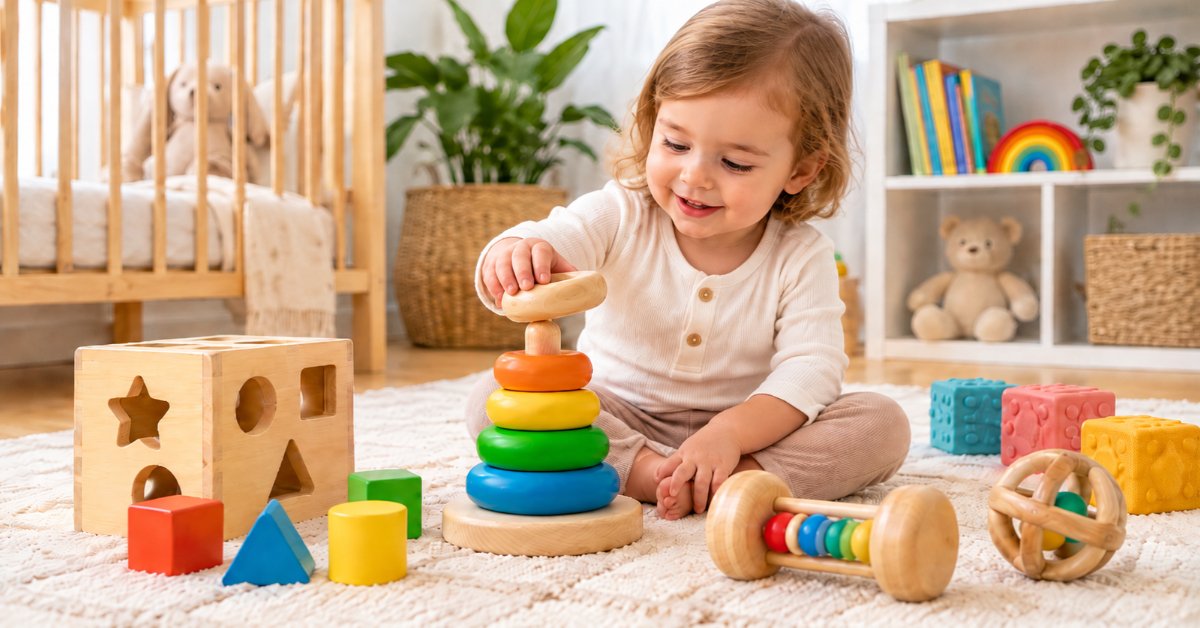
Montessori toys for babies consist of natural materials such as wood, cotton, and wool. These are simple, open-ended toys. Every toy is used to practice one skill. That might be looking, grasping, rolling, or crawling. These toys are safe from birth to 12 months. They must pass the small-parts test. They also have to comply with the US safety requirement, ASTM F963. Place only a few out at a time. Change them as your baby grows.
Maria Montessori had the idea that a child learns best through doing. Her toys follow that idea. They don’t flash. They don’t play songs. They don’t do the work for your baby.
Each toy has one clear purpose. It fits small hands. A wooden ball only rolls when your baby pushes it. That’s cause and effect in action.
Teachers are familiar with this scenario. Simple toys keep babies’ attention longer than loud toys. Ten quiet minutes with a wooden ring is real focus practice.
Your baby grows fast in the first year. Vision, grip, and balance all improve. Montessori toys train one skill at a time.
Materials matter too. Wood feels solid. Cotton feels soft. Each one teaches your baby something new through touch.
A practical insight: Parents often think their baby is bored. Usually the timing is off. Put the toy away for two weeks. Then bring it back. A rattle ignored at three months can be a favorite at four.
Newborns can’t reach yet. They can’t grip either. They see best at 8 to 12 inches. Bold black-and-white patterns catch their eye. So toys at this age are for looking.
A practical insight: New parents often do too much. Watch your baby’s signals. Looking away means “enough.” So does fussing. So does arching the back. Stop and rest. A few calm minutes are plenty.
Your baby’s hands get busy after three months. Toys can get more hands-on.
3 to 6 months: grasping and mouthing
Everything goes in the mouth now. That’s normal. It’s how babies explore.
6 to 9 months: sitting, rolling, and dropping
9 to 12 months: crawling and walking
A practical insight: Don’t put every toy out at once. Choose four to six. Keep them on a low shelf. Swap a few each week. Also, your baby isn’t being naughty when they drop things. They’re testing gravity. A good toy turns that habit into learning.
Natural doesn’t always mean safe. Wood can splinter. Handmade toys may skip testing. Run through this list before every purchase.
Stay close during play. Even a safe toy needs an adult nearby.
Ads can be confusing. Here’s what to skip.
A practical insight: Watch your baby. A baby who comes back to a toy is learning. A baby who ignores it isn’t ready. Try again next month.
Montessori toys for babies work because they’re simple. An age-appropriate selection of toys is better than a full room of dangerous toys. Start using visual aids and add grasping and dropping toys next. Bring in movement toys once your baby crawls. Check every toy for safety. Then follow your baby’s lead.
Montessori learning doesn’t end after the baby years. New Horizons Montessori in Princeton Junction, NJ opened in 1998. The school has more than 25 years of experience. It meets the standards of recognized Montessori institutes. Its teachers are licensed. The school also maintains a nut-free policy for children with allergies. A tour is also available to observe classrooms in action.
Discover how we help children develop skills and attributes that are important for future happiness and success.
Come visit us and learn more.
Book A TourVisit the school | Meet the team | Let us get to know you and your child
Partner with educators | Be involved | See your child grow
Skills for today and tomorrow | Happiness and success for life