
GET STARTED TODAY
Why wait another day?
Discover how we help children develop skills and attributes that are important for future happiness and success.
Come visit us and learn more.
Book A Tour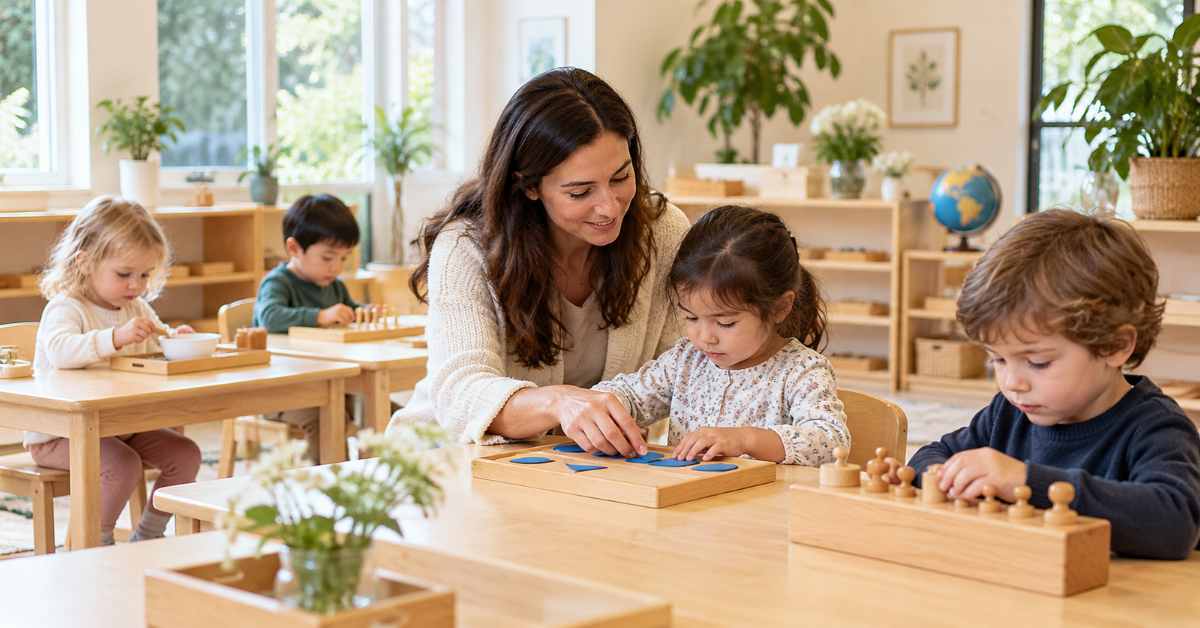
For NH Montessori, early childhood education fosters a child’s independence, concentration, and learning readiness from the age of 18 months to under 6 years. Children work independently through a hands-on, guided program, with the credentialed teachers leading each child. Families looking at Montessori schools in Princeton NJ can find this approach at New Horizons Montessori. The school has been offering Montessori classrooms since 1998. Its Academic Director holds over twenty-five years of Montessori teaching experience.
Dr. Maria Montessori studied how young children learn. Her main finding was simple. Children grow as they choose work and repeat it until they master it. This remains a core concept in all New Horizons Montessori classrooms.
The rooms are tidy and well-lit. They are suitable for small hands. Materials sit on low shelves within easy reach. A child chooses an activity and settles in to work. The teacher walks around the room and watches. When a child is ready for something new, the teacher offers a lesson.
Many traditional preschools work differently. The teacher picks the activity. The whole class gets the same lesson. A Montessori head teacher teaches one child or a small group instead. That depends on the material. A child who is not ready for an idea does not have to sit through it. If a child is ready, they don’t have to wait. The day continues with Art, science, music and the gym.
The Pre-Primary program is for children aged 18 to 36 months. For many families, this is the first school experience. Academics are not the goal at this age. Children learn how to move around a classroom. They learn a simple daily routine. They try small tasks on their own. Pouring water builds hand control and focus. Sorting objects teaches a child to finish one job before starting another. Each small success adds to a child’s confidence.
The Primary program is for children in the 3-6 age band. It begins with two foundations. These are the activities of Practical Life and Sensorial.
Practical Life includes self-control and maintenance of the classroom. Children pour, sort and clean up. The sensorial work allows the children to explore with their senses in an organized manner. Both engage in teaching children academic skills.
Next are writing, reading, and math. Lessons are delivered on a 1:1 or small group basis (three to four children). Matching letters to sounds is something that one child does every morning. Another child counts using materials. The third child pours and sorts. Children select their own work. The room is kept active but relaxed.
Teachers keep careful records. They track what each child has mastered. They use those records to plan the next lesson for that child. Children also take French and Spanish once a week. The classroom welcomes children from diverse backgrounds.
The Primary program shares a classroom with the kindergarten group. Younger children see what older children can do. Older children get a chance to lead. Families can choose half-day, full-day, or full-day extended options for ages 3 to 6.
Kindergarten starts at the age of 5 or 6. The program provides good foundations in math, writing, and reading. Children can go beyond the usual expectations. This takes self-control. It also takes listening and concentration. The classroom builds those habits along the way.
Math shows the method best. Children do not memorize additional facts. They do not memorize multiplication tables. Instead, they do the operations with concrete materials. Counting, addition, subtraction, multiplication and division are covered by different materials.
A substantial portion of the class is new every year. Some children are new to the school. Some are new to Montessori. Some are new to school altogether. The individual approach handles this well. The class includes children at many stages. Teachers meet each child where they are. Some families need a longer day. The After School Enrichment program serves kindergarten and first grade. It starts after 3:30 pm.
The teaching method matters. Daily details matter just as much. The school’s About page lists these features:
None of these features is flashy. Parents notice them every morning at drop-off. They also help a family feel part of a real community.
A tour says more than any brochure. Watch for a few things in any Montessori classroom.
New Horizons Montessori invites parents to tour and watch classroom sessions.
New Horizons Montessori has been serving Princeton Junction families since 1998. The school caters to children between 18 months and 6 years. Academic Director Shaheen Syed has more than 25 years of experience teaching in the Montessori setting. She has co-trained numerous Montessori teachers. She has also served as Treasurer of the New Jersey Montessori Association. The school adheres to known Montessori credentialing requirements. Half-day, full-day or extended-day choices are available for families. For more information, please check our website.
Habits formed in the early years endure a lifetime. These are curiosity, concentration and confidence. They are established in a Montessori classroom through meaningful experiences and careful observation. The teacher knows the individual child well. When parents are considering Montessori schools in Princeton NJ, they should schedule a visit to New Horizons Montessori. Children working really tell their own tale.
Discover how we help children develop skills and attributes that are important for future happiness and success.
Come visit us and learn more.
Book A TourVisit the school | Meet the team | Let us get to know you and your child
Partner with educators | Be involved | See your child grow
Skills for today and tomorrow | Happiness and success for life