
GET STARTED TODAY
Why wait another day?
Discover how we help children develop skills and attributes that are important for future happiness and success.
Come visit us and learn more.
Book A Tour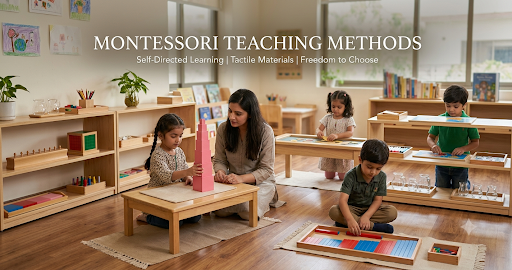
Montessori teaching methods build deep confidence and strong problem-solving skills. This approach replaces memorization with hands-on learning. Children work inside a structured environment. Educational research shows that this design changes how children see mistakes. They choose their own tasks based on their current needs. They do not rely on constant direction from adults. They gain the resourcefulness needed for long-term success in school and their future careers.
True self-confidence does not come from empty praise. It does not come from high grades either. It grows when a child completes a difficult task through their own sustained effort. Traditional schools often hinder this growth. Students constantly look to teachers to grade their work and find errors. It makes them doubt their own abilities.
The Montessori approach completely changes this system. It uses physical objects with a built-in control of error.
These classrooms mix children of different ages together. The mix usually spans a three-year range. This setup helps everyone in the room in unique ways:
Young children learn best through physical movement. Abstract concepts often confuse a developing brain. Physical objects make these concepts real and logical.
The classroom is split into clear, organized areas. Every item sits on a low, open shelf. Children can reach everything safely.
Math is a great example of this hands-on method. Children do not memorize rows of numbers on flat paper worksheets. Instead, they use physical golden glass beads to learn the decimal system:
Children physically move these heavy cubes and light beads across their mats. They add, subtract, multiply, and divide this way. This builds a powerful logical foundation.
Teachers do not stand at a blackboard in these schools. Instead, they act as quiet guides. They observe each child’s progress. They introduce new materials only when a child is ready.
This daily freedom teaches vital skills through practical actions:
This freedom of choice helps children focus deeply. Students stay engaged much longer when they pick their own tasks. Forced activities rarely create this level of concentration. Children learn to manage their workspace. They learn to budget their time. They solve practical problems alone. This helps them handle future higher education with ease.
We can compare them to see why this system works so well.
Traditional education is largely teacher-centred:
Other modern styles also focus on the child. However, they use different developmental pathways:
The Montessori system stands out for a specific reason. It blends absolute personal freedom with a strict underlying structure. The systematically prepared environment gives children a clear framework.
The daily routine uses specific, time-tested strategies. These ideas optimize child development. They build independence through daily practice.
Montessori teaching methods provide children with a strong foundation for the future. Movement from the passive partaking of listening to the active partaking of exploring strengthens inner confidence. It also creates real problem-solving skills. Children guide their own learning inside a beautiful, structured space. This freedom creates self-motivated thinkers. They grow up viewing big challenges as exciting opportunities.
At New Horizons Montessori, we have provided excellent education and childcare since 1998. We follow authentic Montessori principles exactly. We provide child-friendly rooms for children ages 18 months to 6 years. We are committed to maximizing your child’s potential. We foster curiosity and create a solid base for success in the Long Term.
Discover how we help children develop skills and attributes that are important for future happiness and success.
Come visit us and learn more.
Book A TourVisit the school | Meet the team | Let us get to know you and your child
Partner with educators | Be involved | See your child grow
Skills for today and tomorrow | Happiness and success for life